8 August 2000
ALTADENA, CA - Global Aerospace Corporation
announced today that it has been awarded a $600,000
NASA contract to begin the second phase of its
StratoSail(R) balloon flight path control system.
The contract is for building and testing a prototype
of the StratoSail(R) Ballon Guidance System
that may be used to control the direction of travel
on one of NASA's Ultra Long Duration Balloon (ULDB)
missions. Currently the NASA stratospheric balloons
simply drift with the wind. The StratoSail(R)
system will help the balloon maintain a preplanned
flight path.
The StratoSail(R) flight path control technology
can be used to divert balloon flights around uncooperative
countries and dangerous weather systems, or even
for interplanetary missions such as steering balloons
on Venus or Titan. The StratoSail(R) system will
reduce launch and landing complexities by allowing
more control over the balloon's direction of flight,
and will increase the success of payload recovery.
Additionally, this system will allow more control
over scientific missions.
The innovation being developed by Global Aerospace
Corporation utilizes a rudder type system to react
against the different wind streams in the atmosphere.
A wing is suspended on a long tether 15 km (9.3
mi) below the balloon. The wing generates a lift
force that can be controlled to nudge the balloon
system in the desired direction. The balloons
of the NASA ULDB Project are designed to fly at
an altitude of 35 km (21.7 mi). The StratoSail(R)
trajectory control device would be located 15
km below the balloon at an altitude of 20 km (12.4
mi), which is above most aircraft.
The StratoSail(R) system applies only a slight
amount of sideways control force, yet this is
enough to significantly influence the balloon's
trajectory. By controlling the latitude of the
balloon as it drifts around the world, it is possible
to return the balloon to its launch site. This
will increase the chance of recovering the balloon's
scientific instrumentation package and allow the
possibility of reusing it. Payload recovery can
represent a savings of several million dollars
per mission to NASA. A single recovered payload
(that might otherwise have been lost) could offset
much of the development cost of the StratoSail(R)
system.
Advanced StratoSail(R) systems are being developed
that can control global constellations of balloons.
This network of balloons could be used for difficult
low power telemetry operations such as whale tracking.
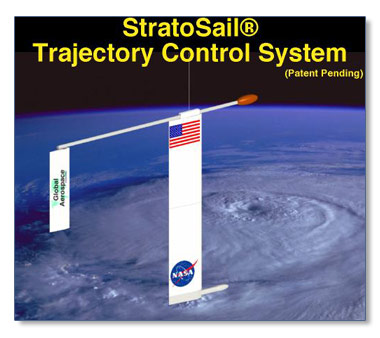
The following figure shows the first generation
StratoSail(R) Ballon Guidance System flying
over a hurricane.
For more specifics, click
here |