FOR IMMEDIATE RELEASE
11 June 2002
ALTADENA, CA -Human Mars exploration becomes a much
closer reality with the establishment of near-Earth
gateways to the Moon and Mars. Global Aerospace Corporation
(GAC) announced today that on June 12, 2002 it will
be reporting on the development of its concept for an
interplanetary rapid transit system between Earth and
Mars at the Annual Meeting of the NASA Institute for
Advanced Concepts (NIAC). Mr. Nock, President of GAC
and a NIAC Fellow, will give this briefing at the NIAC
Annual Meeting to be held at the Lunar and Planetary
Institute in Houston, TX, June 11-12, 2002.
Permanent human habitation and exploration of Mars
is inevitable and only a question of time, sustained
political leadership and resource availability. A revolutionary
concept, which could speed this inevitability, is being
developed for transporting scientists and explorers
between Earth and Mars. This innovative design architecture
(see figure 1) uses highly autonomous, solar-powered,
xenon ion-propelled spaceships, dubbed Astrotels for
astronaut hotels (see figure 2), and small, fast spaceships
called Taxis for trips between Astrotels and planetary
transport hubs or Spaceports. Earth and Mars Shuttles
transport crews to and from orbital space stations and
planetary surfaces.
Astrotels orbit the Sun in cyclic orbits between Earth
and Mars and Taxis fly hyperbolic planetary trajectories
between Astrotel and Spaceport rendezvous. Together
these vehicles transport replacement crews of 10 people
on frequent, 5 month long trips between these Earth
and Mars. Two crews work on Mars with alternating periods
of duty each spending about 4 years there with crew
transfers occurring about every two years. In addition,
autonomous solar-powered, xenon ion-propelled cargo
freighters deliver hardware, fuels and consumables to
Astrotels and planetary Spaceports. The pathways to
an interplanetary rapid transit system between Earth
and Mars are being explored by Global Aerospace Corporation
under funding from NIAC with support from the Colorado
School of Mines (CSM), Science Applications International
Corporation (SAIC), Purdue University and others.
An important cost-lowering element of GAC's transit
concept is the production of rocket fuels for crewed
spaceships using materials mined from the surfaces of
the Moon and Mars and the Martian satellites. The Colorado
School of Mines (CSM) has been developing concepts for
the use of natural resources on these bodies and in
space to produce and store liquid oxygen and hydrogen
rocket fuels. Work at CSM has included evaluation of
excavation and extraction systems for the production
of water, oxygen, and hydrogen, and the building of
simple prototypes of some of these systems.
GAC's concept provides a framework and
context for future technology advance and robotic Mars
exploration. Robotic explorers have been used on Earth
in a variety of environments and for short-term exploration
on Mars and are a natural adjunct to human operations.
Permanent self-sustaining Mars habitation, instead of
brief and expensive expeditions are more desirable and
practical and the Astrotel system will bring us closer
to that goal.
 |
Mars Transportation Architecture
Schematic
|
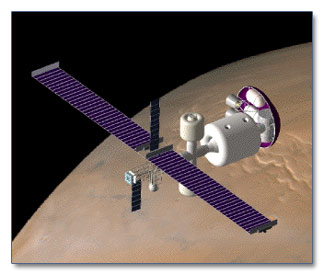 |
Taxi Docked at Astrotel near Mars
|
For more details and pictures, click
here
|